
Oopbuy Spreadsheet buying choices that change the box
Spreadsheet sites, sellers and listings, judged by one extra question each: what will this choice do to my parcel.
How to choose a spreadsheet site
A spreadsheet site is only as useful as its upkeep. Four tests take a minute.
- Links resolve. Open three category links. A dead page or an empty category means nobody maintains the list.
- Numbers carry dates. Fees, limits and offers without a date cannot be checked and are often stale.
- No counterfeit framing. Oopbuy's own guidelines prohibit counterfeit goods and allow the warehouse to destroy them without shipping or refunding. A site that sells you on copies is selling you that outcome.
- A name and a contact. Someone who answers when a link or figure is wrong.
Hold this site to the same tests. Our route data is dated October 10, 2026, the catalogue destinations follow the prescribed category mapping, and the change log records corrections.
How to choose a seller
Seller choice is usually about ratings, sales and real buyer photos. Those still come first. Four further signals matter once the item has to join a parcel.
- Package details in the listing. Sellers who print weight and box size save you a guess at the 90 cm and weight-window questions.
- Clear material and battery notes. You need these to know which route list the item joins.
- Guaranteed returns offered. The 5-day return service only covers items whose seller offers guaranteed returns.
- Fast dispatch. A slow seller holds up the box while the storage clock runs on everything already in the warehouse.
A seller who answers a pre-sale question about package size is worth more for parcel planning than a slightly lower price.
How to choose items that pack well
Some choices between two similar listings are really choices about the box.
- Compression can reduce volume on a suitable jacket, but the final charge still depends on the route and billed weight.
- Between two watches, the automatic one avoids the battery route list that a quartz or smart watch joins.
- Presentation packaging can change volume substantially; compare actual dimensions before choosing to remove protection.
- Between a 95 cm and an 85 cm version of the same item, the shorter one can share your parcel.
None of these is a reason to buy something you do not want. They are tie-breakers, and the tie comes up more often than you would think.
Things to watch before you pay
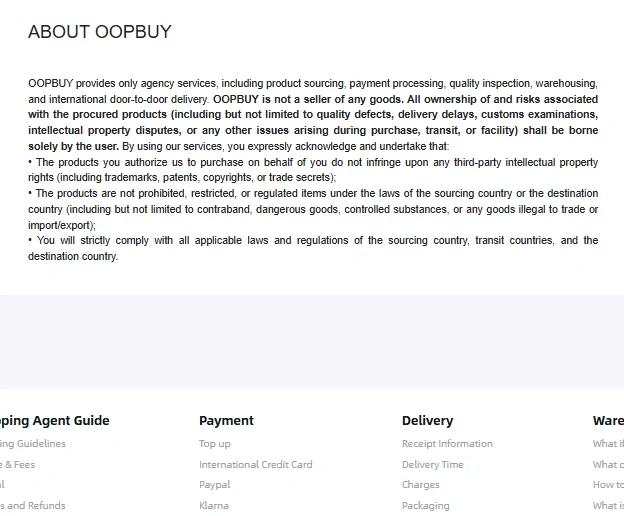
The operator's own declaration on its role is worth reading before your first order. Oopbuy describes itself as providing agency services only, not as the seller of any goods, and says that ownership and risks associated with the procured products, including quality defects, delivery delays, customs examinations and IP disputes, are borne by the buyer.
For parcels, that statement turns into a short list of things to settle before paying for goods: whether any item is 90 cm or longer, whether any item carries a battery, liquid or powder, whether the total will pass 10 kg, and whether you can build the parcel inside 90 days of the first item arriving.
The box split check answers the first three in one go.
Mistakes that force a second parcel
Four habits account for most unplanned second parcels.
- Buying a 90 cm piece late. It ships alone regardless, so adding it to a finished haul saves nothing and delays the rest.
- Adding one gadget to a clothes box. The route list shrinks to the battery routes, often the pricier ones.
- Waiting past the free days. Storage charges start, and a split you postponed becomes urgent.
- Ignoring the 10 kg warning. A heavy box may meet commercial treatment at customs.
Each one is easier to avoid at the cart than to fix at the warehouse.