Oopbuy Spreadsheet commercial parcel signals and declarations
A parcel can fit every route and still look like trade goods to customs. Weight, quantity per item and the declared value are the three signals.
Ten kilograms and the commercial question
The same reminder appears on the Packaging page, in the FAQ about shipping in one go or in batches, and in the customs notes: an important basis for customs to judge whether a parcel is personal or commercial is its weight and the quantity of a single item, and a parcel over 10 kg is relatively likely to be treated as commercial.
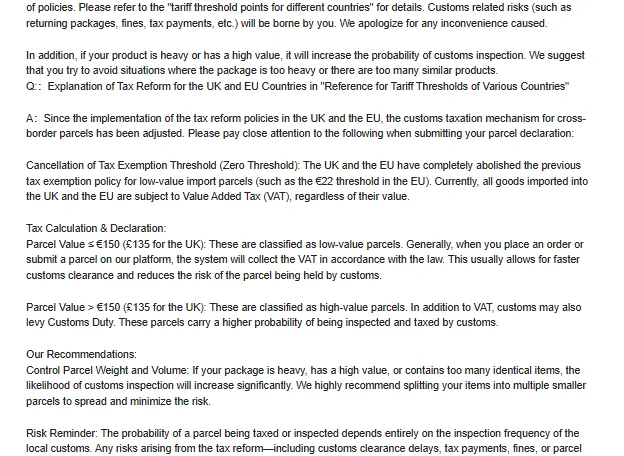
Ten kilograms is not a route limit. GOFO stops at 10 kg, but OopLine takes 30 kg and some UPS routes far more. The warning is about what happens after the route has done its job. A commercial classification can bring duties, paperwork or delay that a personal parcel would not meet.
It is also the strongest argument for splitting a box that every route accepts. Two parcels of 6 kg each cost more in shipping than one of 12 kg, but they sit on the personal side of the line the operator itself describes.
Many identical items in one box
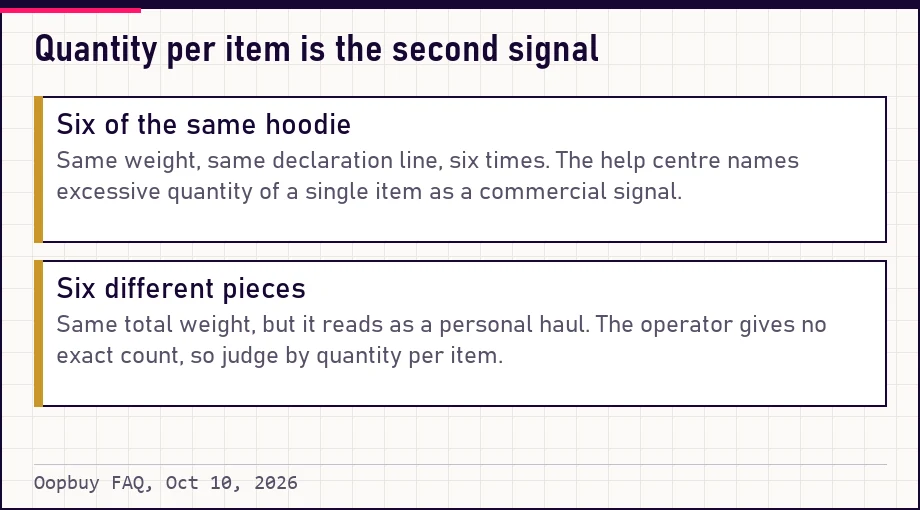
The second signal is quantity per item. The FAQ asks you to avoid sending a large amount of the same product in one parcel, because excessive quantity of a single item is also a basis for treating it as commercial.
The operator gives no number. Six of the same hoodie in one colour reads differently from six different pieces of clothing at the same weight. The box split check prints a note at five or more of one item; that threshold is ours, chosen as a prompt to think, not a rule from Oopbuy or from customs.
If you are buying for friends, the same logic suggests separate parcels for separate people.
Self declaration or fuzzy declaration
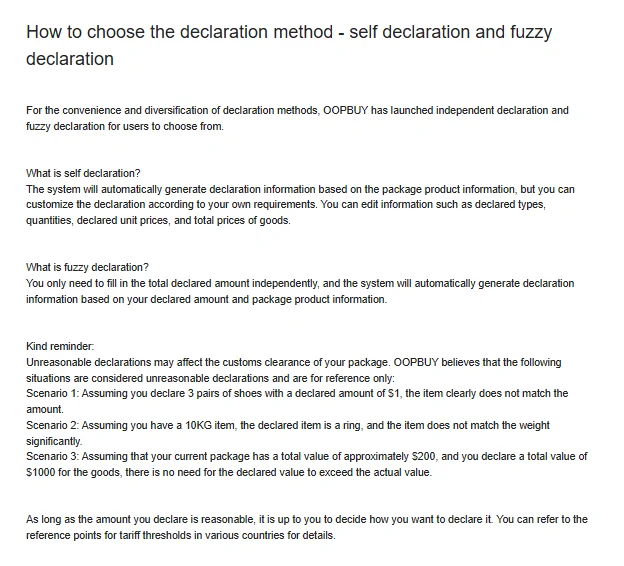
When you submit a parcel you choose how to declare it. Self declaration: the system fills in the declaration from the package's product information, item types, quantities, unit prices and totals, and you can edit it. Fuzzy declaration: you enter only the total declared amount and the system generates the rest.
The article closes with a principle: as long as the amount you declare is reasonable, how you declare it is up to you. The operator also warns that unreasonable declarations may affect customs clearance, and that customs risks, duties and fines are borne by the buyer.
The customs declaration fee itself is generally 8 CNY per parcel, depending on the route. Splitting a box into two parcels means two declarations and two fees.
All fees are on the fees page.
Examples the operator calls unreasonable
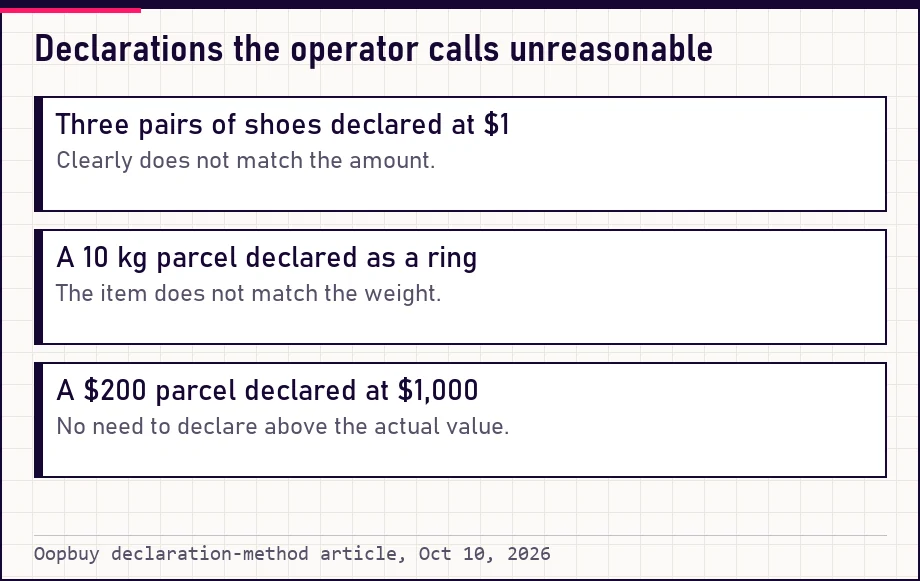
The same article gives three scenarios as examples of unreasonable declarations.
- Three pairs of shoes declared at $1: the item clearly does not match the amount.
- A 10 kg parcel declared as a ring: the item does not match the weight.
- A parcel worth about $200 declared at $1,000: there is no need to declare above the actual value.
The second example connects declaration to this site's subject. Weight is visible to everyone handling the parcel. A declaration that does not match the weight invites inspection, and a 10 kg parcel is already on the commercial side of the operator's line.
The third example is a reminder that over-declaring is not a safe default either; it can raise duties where they apply.
Tax-free lines, DDP lines and recipient-pays lines
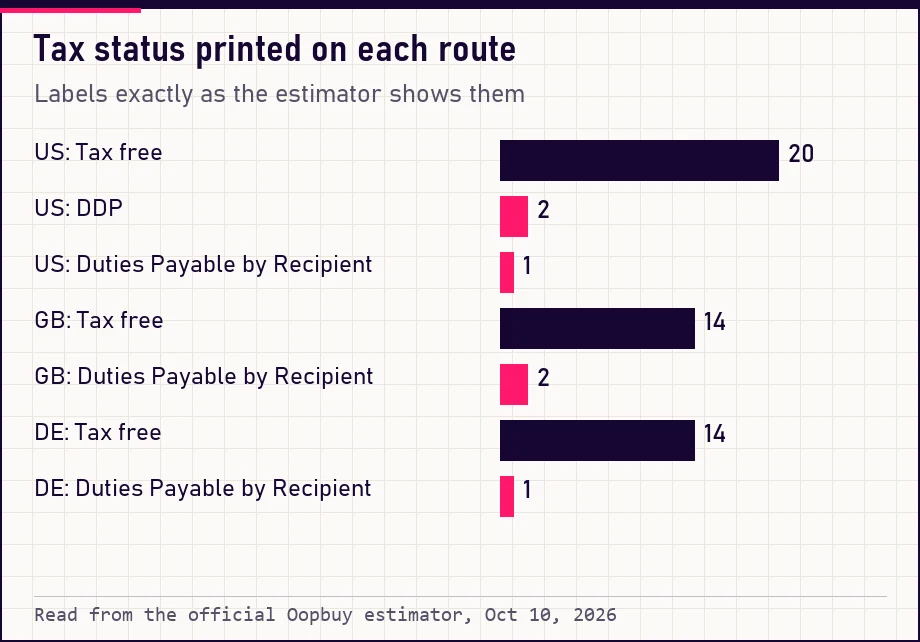
Every route on the estimator carries a tax label. On October 10, 2026 the US list had 20 routes marked Tax free, 2 marked DDP and 1 marked Duties Payable by Recipient. The UK list had 14 tax-free routes and 2 where the recipient pays; Germany 14 and 1.
The two US DDP lines, HF-EUB-US-1 and HP-EMS-US-1, also carried a 50 CNY clearance fee in the quote. Tax free on a route label describes how that route clears goods; route descriptions such as GOFO's call it a tax-inclusive channel with commercial customs clearance.
None of this changes the commercial signals. A heavy parcel of identical items on a tax-free line is still a heavy parcel of identical items.
The estimator shows the label for each route. Check it on the official estimator.
The operator's customs notes
The Customs and Taxation page adds three practical points. If a product is heavy or has a high value, the probability of customs inspection rises, so avoid situations where a parcel is too heavy or holds too many similar products. Since the UK and EU reforms, tax applies to all imports, and for parcels up to EUR 150 (GBP 135) VAT is collected on the platform; above that, customs duty may apply. And the operator recommends splitting parcels that are too heavy or valuable to spread the risk.
The FAQ also carries a reference table of tariff thresholds by country. The operator itself calls it a reference, and thresholds change with national rules, so check your own country's customs authority before relying on a figure from any agent's table.