Oopbuy Spreadsheet box split check
List what you plan to ship. The check separates what must travel alone, tests the rest against every route we read, and names the item to move if nothing fits.
Check a box before you submit it
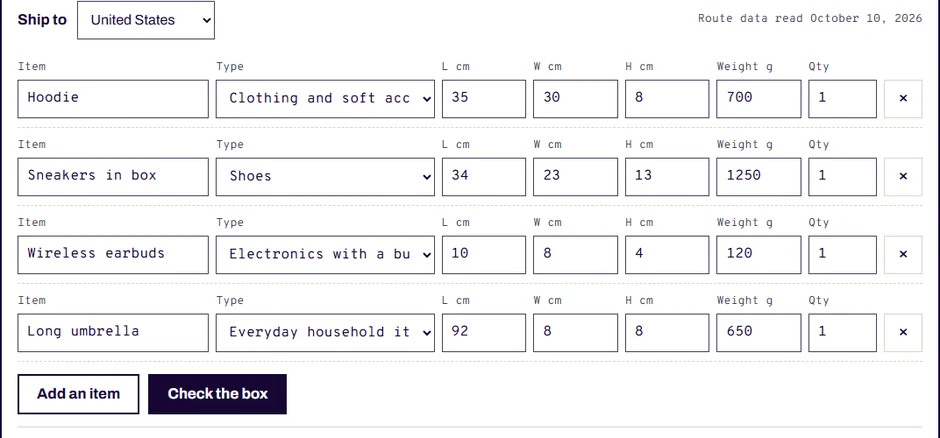
Pick a destination, adjust the example items or add your own, and press Check the box. Sizes are in centimetres, weights in grams. The carton size fills itself with a stacked-flat guess; change it to the carton you expect the warehouse to use.
Carton you expect to use (cm), filled with a stacked-flat guess you can edit
Route data was read from the official estimator on October 10, 2026. The official estimator on the day you submit is the final word, and the estimator lets you check any route yourself without logging in.
How to use the tool, line by line
Each line of the form is one item. Give it a short name, choose the type that matches the listing, and enter three dimensions and a weight. The order of the dimensions does not matter; the check sorts them so the longest side is tested against the 90 cm rule and against each route's longest-side limit.
Use the quantity field for several of the same item. Quantity matters twice: it multiplies the weight, and five or more of one item triggers this tool’s reminder. Five is an editorial prompt, not an official customs threshold; the operator describes excessive quantities without a universal numeric cutoff.
Where do the numbers come from? The best source is the warehouse photo, which prints the measured weight in grams and the size in centimetres. Before the item arrives, use the listing's package size if the seller gives one, or a similar item you own.
The warehouse and QC page shows where those measurements appear.
What the check knows and what it leaves out
The check carries 54 routes: 23 for the United States, 16 for the United Kingdom and 15 for Germany. For each route it holds the minimum and maximum parcel weight, the size formula exactly as the estimator prints it, the volumetric coefficient, whether the route bills on actual weight only, the list of accepted item types and the tax label.
It leaves out prices, coupons, remote-area surcharges and the weight of packing material. It also cannot see capacity on the day you ship. Some routes cap the number of parcels per day; on October 10, 2026 two German DHL routes and one Royal Mail route showed this message: “the available capacity for this route is currently: 0 packages”, with capacity refreshed daily at 12:00 PM China time. Those routes are marked as such in the results.
Reading the result: alone, together, nowhere
The result has up to three blocks.
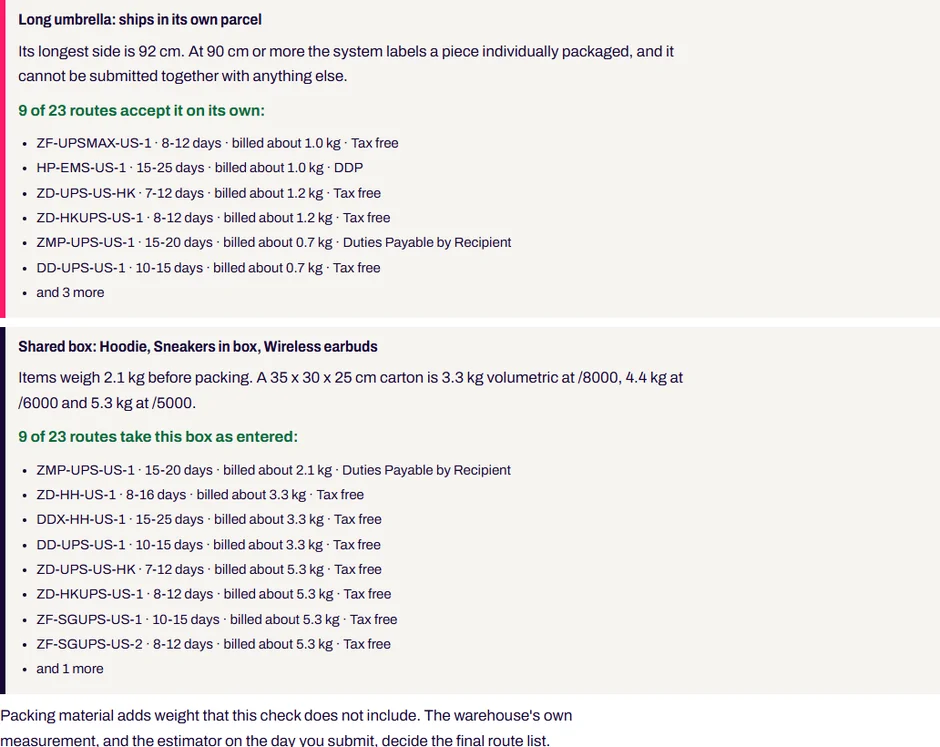
- Ships in its own parcel. Any item with a side of 90 cm or more, with the routes that accept it by itself. On the US list that is at most 9 routes, all UPS or EMS type lines.
- Shared box. The other items, their combined weight, the carton's volumetric weight at /8000, /6000 and /5000, and the routes that accept every item type, the carton size and the weight. Routes are sorted by indicative weight before route rounding. This tool does not calculate a price.
- No route. If nothing accepts the box, the check counts the reasons across all routes and tests which single item, moved out, opens the most routes for the rest.
A customs block appears when the shared box passes 10 kg or holds five or more of one item.
Worked example: hoodie, sneakers, earbuds and an umbrella
The example items are deliberately awkward. The umbrella is 92 cm long, so it leaves the box at once and is offered the US routes that take a long, light parcel. The earbuds carry a built-in battery, which cuts the shared box down to the battery routes. The boxed sneakers set the carton's footprint.
In the US the umbrella is offered 9 of 23 routes and the shared box another 9, all of them battery-capable lines. Switch to Germany: 12 of the 15 German routes allow a longest side of 90 cm by size, and 9 accept this umbrella once item type and capacity are counted. In the UK only 4 of 16 do. Delete the earbuds and watch the shared-box route list grow back. That is the whole point: one item, decided before you buy it, changes which routes are left.
If the result says no route, try moving the named item out, or read size limits for custom logistics.