
Oopbuy Spreadsheet size limits and the ninety centimetre rule
One long side sends an item into its own parcel. After that, each route measures the carton its own way. Both rules, with the formulas as printed.
The 90 cm rule: one long side ships alone
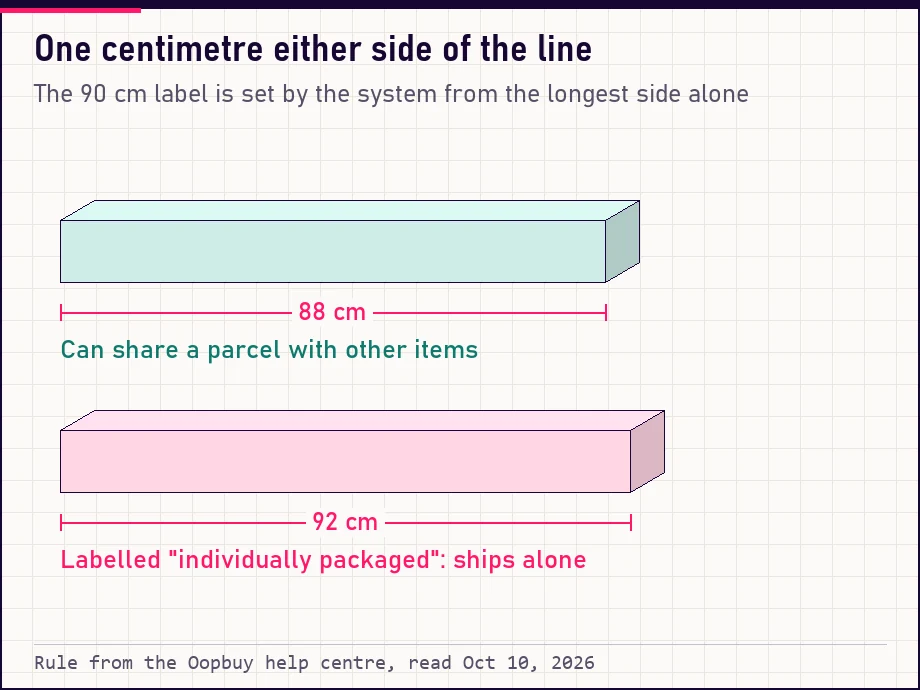
Two help-centre articles define the rule. The first: for the sake of reasonable packaging or to reduce volume and weight, if the length of one side of a product is greater than or equal to 90 cm, the system automatically sets a separate packaging label, and the product has to be shipped separately. The second: a product marked individually packaged cannot be submitted for shipping together with other products.
Three consequences follow. The label is automatic, so you cannot talk the warehouse out of it. It depends on one side only, so a light, thin item is caught as surely as a heavy one. And it is decided by the product's measured size, so a 92 cm item stays a 92 cm item even if the box it came in is shorter in your head.
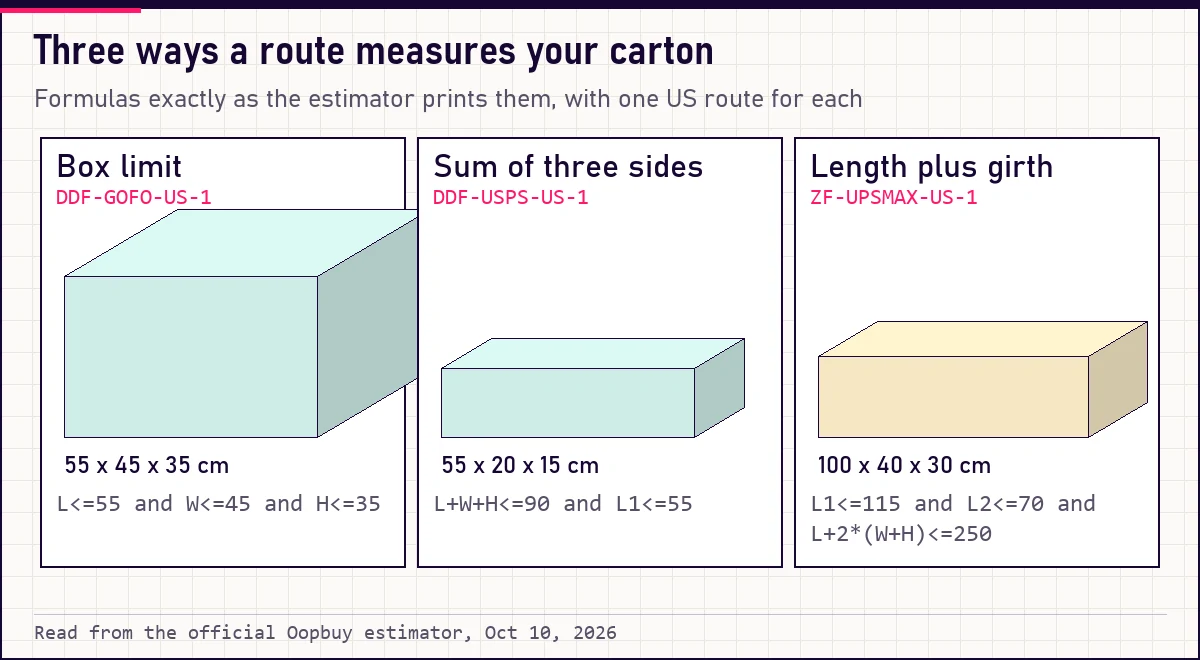
Three ways a route measures your carton
Once the 90 cm question is settled, every route applies its own size rule to the finished carton. The estimator prints them as formulas. We found three shapes of formula across the 54 routes we read.
| Formula type | As printed | What it means |
|---|---|---|
| Box limit | L<=55&&W<=45&&H<=35 | Each side has its own cap. Used by GOFO, OopLine, most Royal Mail and DHL lines. |
| Sum of sides | L+W+H<=90&&L1<=55 | The three sides added together, plus a cap on the longest. Used by USPS and EUB lines. |
| Length plus girth | L1<=115&&L2<=70&&L+2*(W+H)<=250 | Longest side, second side, and length plus twice the other two. Used by UPS and EMS. |
L1 is the longest side and L2 the second longest. Where a formula says L, W and H, read them as the sides sorted from longest to shortest; that is how the box split check applies them.
Small-packet lines stop at about 55 to 60 cm
On the US list, 14 of 23 routes cap the longest side at 60 cm or less. That includes every low-cost line: the two GOFO and UNI lines at 55 x 45 x 35 cm, OopLine at 55 x 40 x 35 cm, the USPS lines at 55 cm with a sum-of-sides limit, and one small line, DDB-HH-US-1, at 30 x 30 x 25 cm.
In the UK the standard Royal Mail lines allow 50 or 60 cm. Two DPD lines take 98 x 70 x 60 cm, and DDF-RoyalMail-GB-BIG allows 120 cm on the longest side. Germany is the generous one: most DHL routes take 115 or 120 cm, and DDD-DPD-DE-1 allows a longest side of 250 cm.
The practical reading: a carton longer than 60 cm, even without any single 90 cm item, moves your parcel off the cheap lines in the US and UK. Sneaker boxes laid end to end, a long bag, or a coat folded in a garment box can do it.
The box split check tests your carton against every formula.
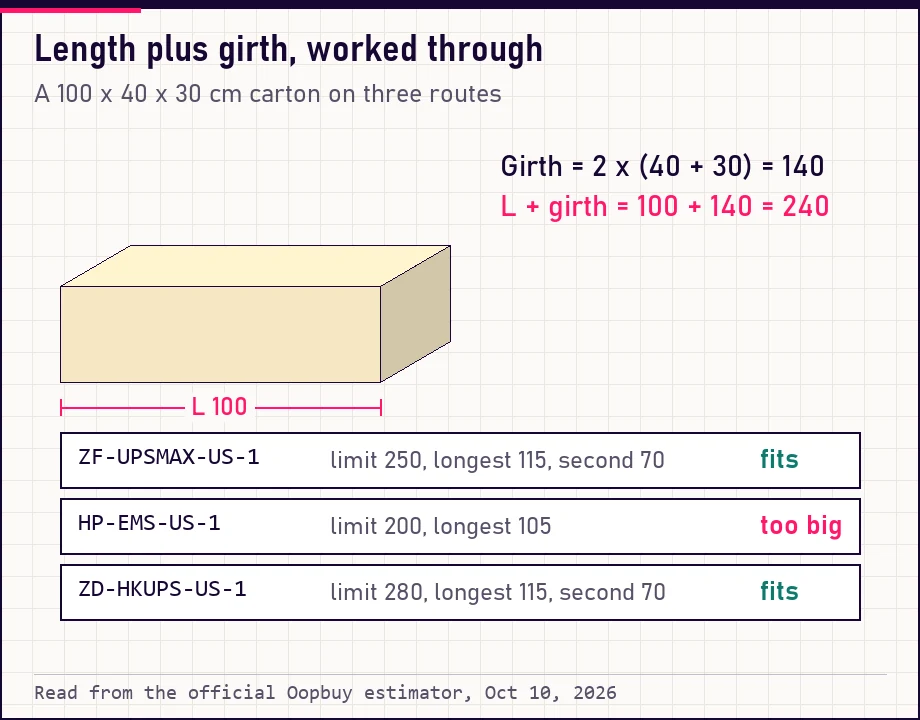
Length plus girth, worked through
Girth is the distance around the carton's thickest part: two times width plus two times height. Length plus girth adds the longest side to that. A 100 x 40 x 30 cm carton has a girth of 140 cm and a length plus girth of 240 cm.
Against the three UPS-type US routes that tells three different stories. ZF-UPSMAX-US-1 allows 250: fits. ZD-HKUPS-US-1 allows 280: fits. HP-EMS-US-1 allows 200 and a longest side of 105: too big, even though the longest side passes.
A thin long carton does better than a cube of the same volume under girth rules. That is why a 92 cm umbrella in a slim tube passes routes that would refuse a 60 x 60 x 60 cm box.
Under a sum-of-sides rule the arithmetic is simpler: add the three sides. DDF-USPS-US-1 allows 90 cm in total with no side over 55 cm; DDF-USPS-US-BIG allows 110 cm.
Measure items before they reach the warehouse
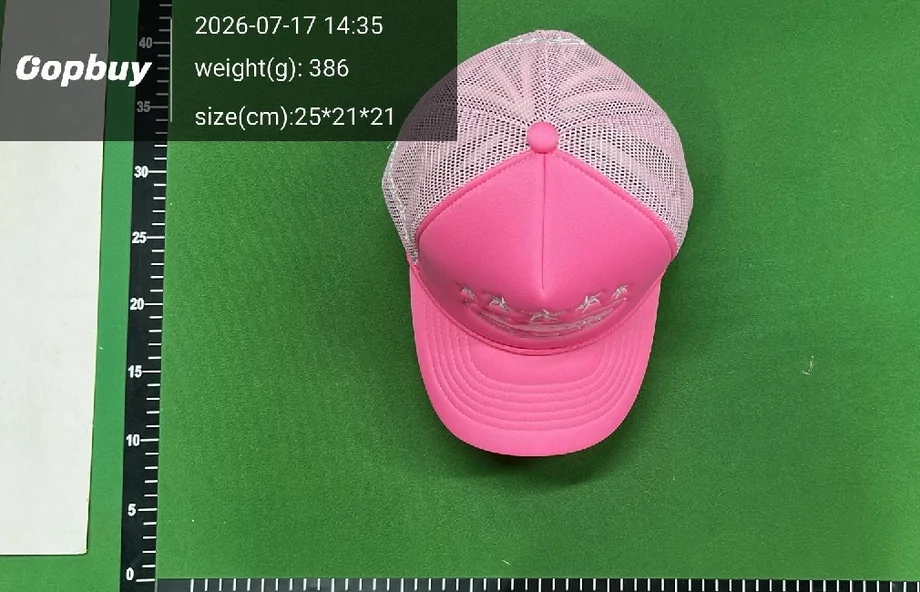
Every inbound package is opened, weighed and stored. The warehouse photo that follows carries a caption block with the date, the weight in grams and the size in centimetres. The one below shows a cap: 386 g, 25 x 21 x 21 cm, on a measuring mat.
Those three numbers are the honest input for any split decision. Before the item arrives, you are guessing from the listing. After it arrives, you know. If an item comes in near the 90 cm line, you will see it in the caption before you build the parcel.
More about photos on the warehouse and QC page.
When nothing fits: custom logistics
If an item is too long for every listed route, or your country has no suitable route, the help centre points to custom logistics. It is an offline service: a logistics team quotes a route based on the goods and the destination, using sea freight, rail, dedicated lines, small packets or express.
There is no public price list for it, so treat it as a quote you request, not a route you pick. Send support the item list with real dimensions and weights, which is another reason to wait for the warehouse measurements.
Contact options are on the help page.