Oopbuy Spreadsheet weight bands by route
Oopbuy has no global weight limit. Each route has a window, a rounding step and a volumetric coefficient, and your parcel has to land inside all three.
No global weight limit, only route windows
Ask what the maximum parcel weight is and the honest answer is: it depends on the route. The estimator prints a minimum and a maximum for each one. On October 10, 2026 the US list ran from routes that stop at 4.5 kg to one that accepts 100 kg.
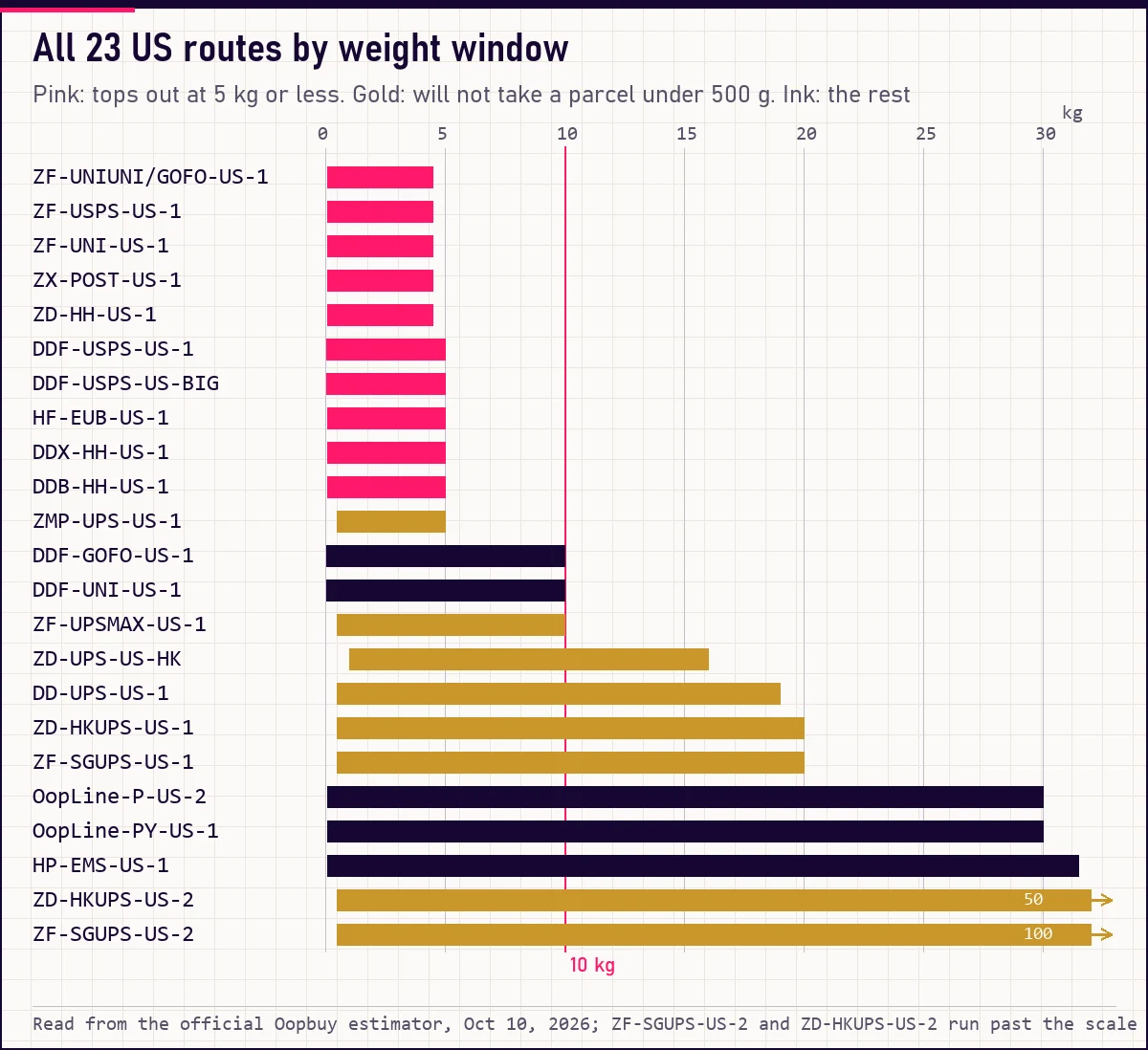
Three clusters stand out. Small-packet lines such as the USPS, UNI and post routes stop at 4.5 or 5 kg. GOFO and UPSMAX stop at 10 kg. OopLine, EMS and most UPS routes go to 16 kg and beyond. If your box is drifting towards 5 kg, you are about to leave the cheapest cluster; if it is drifting towards 10 kg, you are about to leave GOFO.
Below the minimum: when a parcel is too light
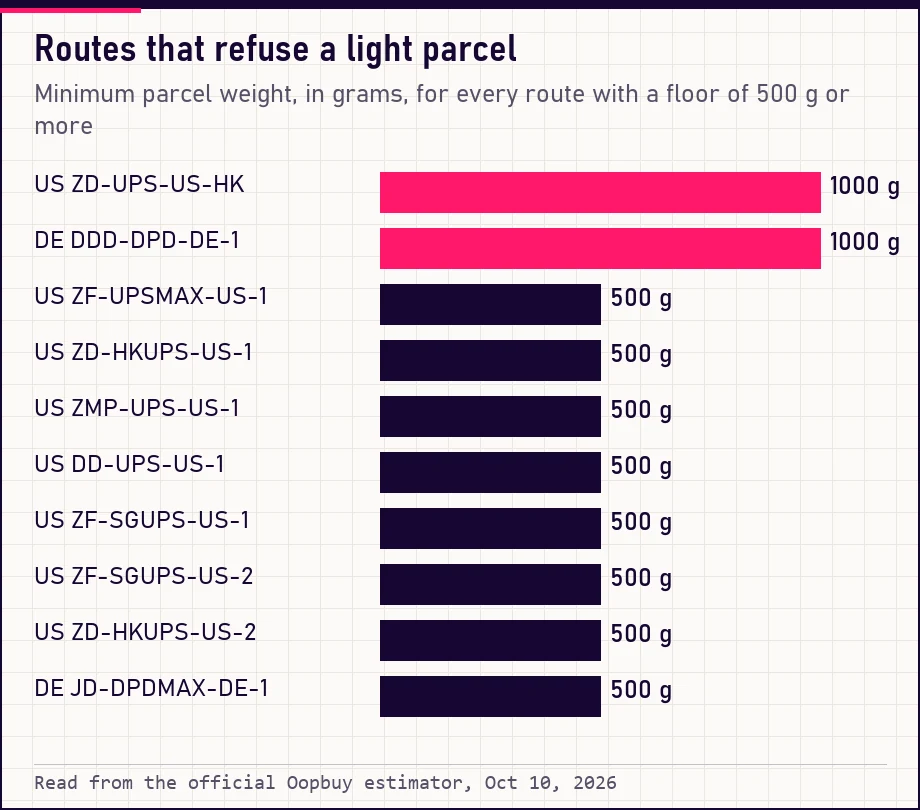
Minimums get less attention than maximums, but they bite on the routes people choose for speed. Every UPS-type route on the US list refuses a parcel under 500 g, and ZD-UPS-US-HK refuses anything under 1 kg. In Germany, JD-DPDMAX-DE-1 starts at 500 g and DDD-DPD-DE-1 at 1 kg.
This matters when you split. Pulling a small item out of a box to ship it fast can leave it below the floor of the route you wanted. A 300 g watch on its own cannot ride a UPS line in the US list at all.
Most other routes start at 50, 100 or 200 g, so a light parcel always has somewhere to go; it just may not be the route you had in mind.
The chart lists every route we read with a floor of 500 g or more.
First weight, continued weight and the rounding method
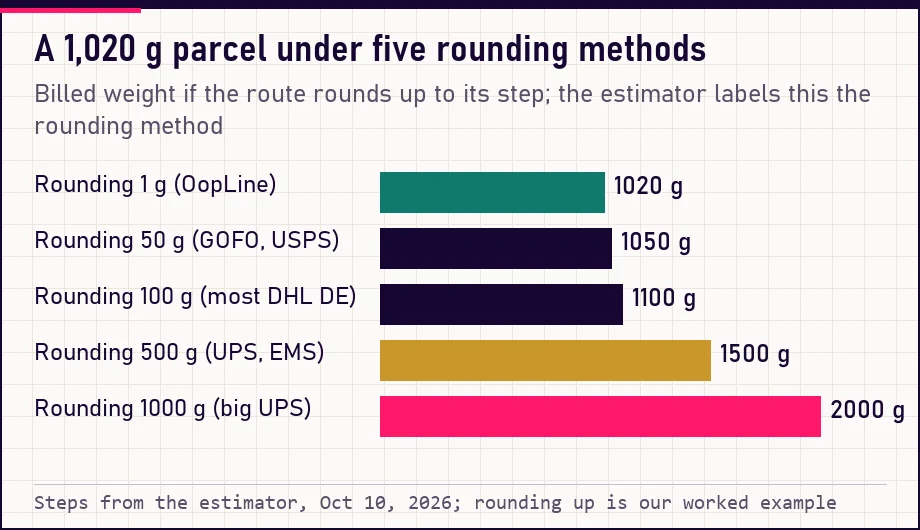
Each route's details panel lists a rounding method next to the weight limits. For the GOFO line it reads 50 g. Other routes use 1 g, 100 g, 500 g or 1000 g. The estimator also shows a first weight and a continued-weight step for each route, which is how the price builds up.
The effect is easy to see with one parcel. If a route rounds up to its step, a 1,020 g parcel is billed at 1,020 g on a 1 g route, 1,050 g on a 50 g route, 1,100 g on a 100 g route, 1,500 g on a 500 g route and 2,000 g on a 1000 g route.
So on coarse-step routes, the last 20 g you add can cost a full step, and the first 480 g after a step are free. Plan heavy express parcels to sit just under a step, not just over it.
Actual weight versus volumetric weight
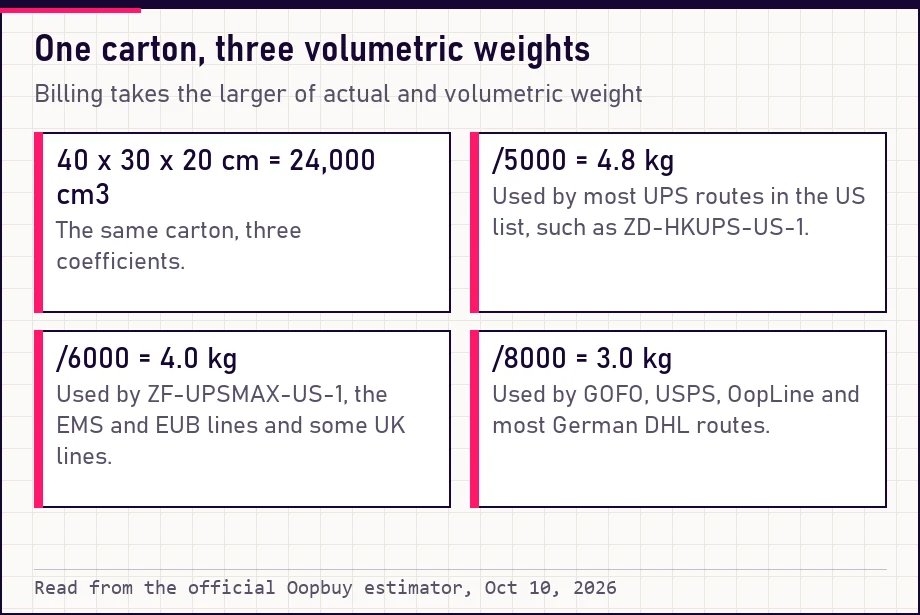
For most routes the estimator bills the larger of two numbers. Actual weight is the goods plus the packing material. Volumetric weight is length x width x height in centimetres divided by a coefficient. The help centre gives 5000 and mentions other divisors depending on the logistics provider; the estimator shows 8000, 6000 and 5000 in use.
The coefficient is not a detail. The same 40 x 30 x 20 cm carton is 3.0 kg at /8000, 4.0 kg at /6000 and 4.8 kg at /5000. A carton of clothes that weighs 2.5 kg is billed on 2.5 kg on GOFO but on 4.8 kg on a /5000 UPS route.
A few routes bill on actual weight only. On the US list these are HF-EUB-US-1 and ZMP-UPS-US-1, in the UK HF-EUB-GB-1, and in Germany the sea route HF-SAL-DE-1. For a light, bulky box these can beat faster routes by a wide margin.
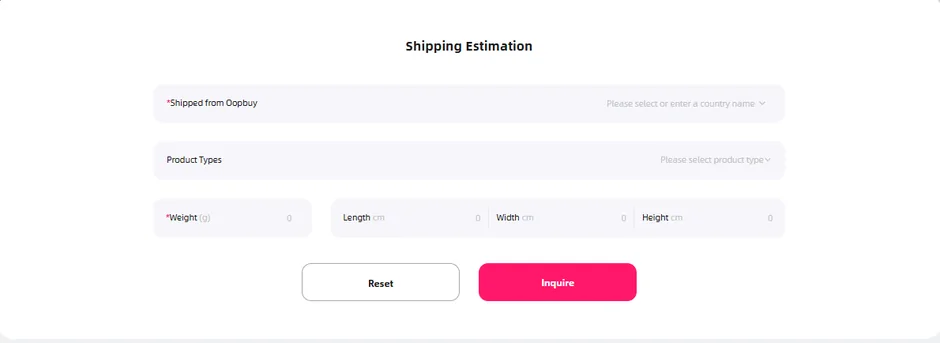
The estimator form asks for length, width and height for exactly this reason. Try it on the official estimator.
One carton, three coefficients
Which routes use which coefficient, from the routes we read:
- /8000: GOFO, UNI, USPS, OopLine and the small post lines in the US; most Royal Mail lines in the UK; almost every DHL route in Germany.
- /6000: ZF-UPSMAX-US-1, HF-EUB-US-1, HP-EMS-US-1; in the UK the EUB, EMS, Hermes and DPD lines; in Germany the sea route.
- /5000: most UPS routes on the US list, including ZD-UPS-US-HK and ZD-HKUPS-US-1.
If your box is bulky and light, prefer /8000 routes. If it is dense, such as jeans, belts and boots, the coefficient matters less because actual weight wins anyway.
Vacuum bags, shoe boxes and other volume decisions
The packaging page gives five pieces of advice, and each one is really about volume.
- Clothes only: simple packaging plus vacuum bags, where the route supports simple packaging.
- Shoes plus clothes: carton packaging, shoe boxes removed or folded, clothes vacuum-packed around them.
- Batteries: battery routes cost more, so ship battery items with small, light things and split smartly.
- Protection on a budget: bubble wrap and stretch film.
- Bulky items such as puffers and plush toys: vacuum bags are a must.
All of them shrink the carton, and a smaller carton matters twice: lower volumetric weight, and a better chance of fitting the 55 x 40 x 35 cm limits of the cheap lines.
Pre-weigh with rehearsal packing
Rehearsal packing, also called preview packaging or parcel rehearsal, is the one tool that turns all of the above from estimate into fact. You select the items, the packing method and the route; the warehouse packs the parcel within 24 hours and reports the real weight. It costs 20 CNY per parcel.
If you then submit with the same route, packing method and details, the rehearsal weight is used as the final weight and no extra charge follows. If you change any of them, the parcel is billed on the configuration you submit. You can cancel and get the 20 CNY back only before the items are taken off the shelf.
For a large or borderline box, near 5 kg, near 10 kg or near a step on a coarse route, 20 CNY is cheap insurance against a supplementary payment.
All warehouse fees are listed on the fees page.
When the final weight differs from the estimate
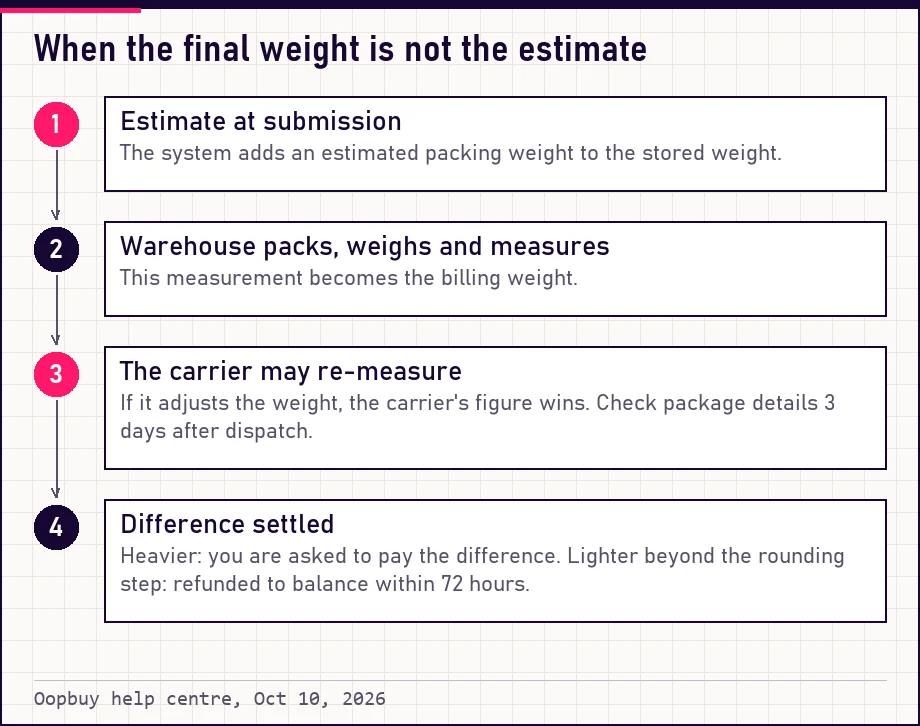
Without a rehearsal, the system estimates the packing weight when you submit, based on the stored weight of each item with its original packaging. If you ask for packaging to be removed, the estimate and the result will not match. After packing, the warehouse weighs and measures the parcel. If the carrier then re-measures it, the carrier's figure becomes the billing weight; you can check the final chargeable weight in the package details three days after dispatch.
If the final weight is higher, you are notified to pay the difference. If the estimate was higher than the final weight by more than the rounding step, the difference is refunded to your Oopbuy balance within 72 hours of dispatch.